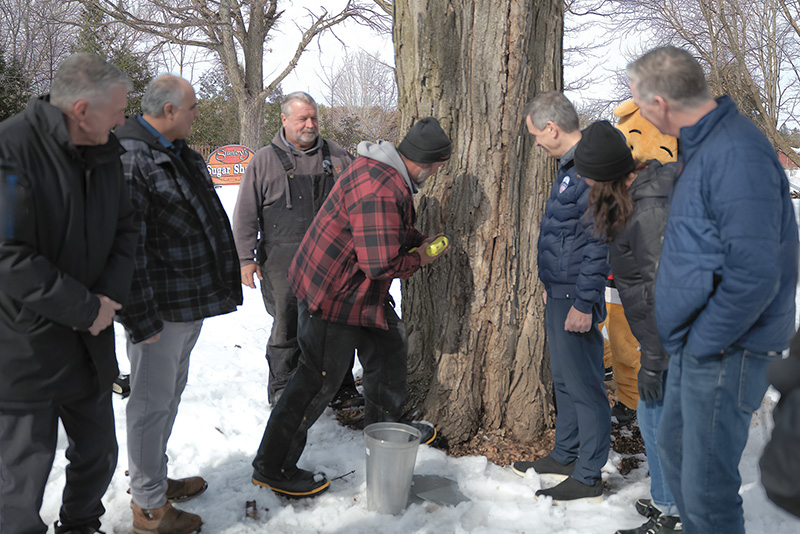
Claude Pepin of Stanley’s Olde Maple Farm drills a small hole in the maple tree to allow the sap to escape while the others look on. From left: Bruce Fanjoy, MP Carleton Riding, George Darouze, MPP, Carleton, Earl Stanley, Claude Pepin, Ottawa Mayor Mark Sutcliffe, Isabelle Skalski, Ottawa Councillor, Ward 20 Osgoode, Michael Barrett, MP, Leeds-Grenville-Thousand Islands and Rideau Lakes. Tinkess Photo
EDWARDS – For those who live in eastern Ontario, one of the surest signs of spring is the tap, tap, tapping which occurs as the sweetest taste in nature is coaxed out of the stately maple trees which make up such a large part of our temperate, broadleaf forest.
For 200 years, the trees which surround Stanley’s Olde Maple Lane Farm at 2452 York’s Corners Road have been a part of that annual tradition, and it continued with the symbolic first tapping on Sat., March 1.
It was a beautiful, sunny, mild day, but truth be told, just a bit colder would have been nice since there is no easy way to go from winter to spring without a bountiful supply of slush and water, but the staff at Stanleys were busy doing their best to make sure there were clear paths available for everyone.
Just prior to the actual tapping, Earl Stanley spoke to the dignitaries and media in attendance, to provide a bit of context for what the making of maple syrup means, and a bit about the leadership of Stanley’s going forward.
“Stanley’s Olde Maple Lane Farm is going to take a definite transition,” said Earl Stanley. “Kendra and Sierra are the next generation, and I’m looking to step back, so please, any questions, ask them, or Colin, our operations manager, because I probably won’t tell you the right thing, and I’ll get corrected.”
Kendra and Sierra are Earl’s daughters, and they have been taking on more responsibility for a while now, so this is just the expected transition.
“The farm, the land grant, we were told was in 1787,” continued Earl Stanley. “The old gentleman who was here was a bachelor, and we bought the farm. He had died in September of ‘92 and we bought the farm from the estate in the spring of ’93. He’d always considered us family because his great, great, great grandmother, or whatever, was Sarah Loney, and she married in the Stanley family.
“So, as kids, my younger brother, Ron and I, we’d be always popping in and helping. We were fortunate enough to help handle hay for a penny of bail. Pick raspberries for ten cents a pint. He was a great old gentleman, a very innovative recluse, and he told us that the family started making maple syrup in 1826. And we never forgot it. That was what we were told, and give or take a year or two, 1826.”
With all the invited guests now present, it was time to get to work. Claude Pepin, a Stanley’s employee, drilled a small hole in the majestic Maple, which was selected, then tapped the spile, the small metal spigot whose function is to allow sap to flow from the tree and into a bucket. With the bucket in place, and with the cover attached, all that was left to do was wait for the tree to give up its bounty. The secret, as any maple syrup maker will tell you is to have warm days and cold nights, since that temperature variation is required to keep the sap running. Since it takes 40-50 gallons of sap to make one gallon of maple syrup, you want as many days with that type of fluctuation as possible.
There was much more than just the symbolic tapping taking place at Stanley’s though. Every Saturday and Sunday from now until April 12 you can stop by to enjoy the heritage sugar shack, tractor drawn rides, the activity centre, museum, heritage animal barn and walking trails. You can take time for shopping in the Farm Shop, see what taffy on the snow really tastes like, or stop by the pancake house for a delicious meal of pancakes, ham, sausage, eggs, hash browns, beans and hot beverages and cold drinks as well.
If there is a tastier harbinger of spring than maple syrup, it would be difficult to find.

Terry Tinkess is a professional photographer, educator and journalist. He has been making a living with a camera and keyboard since 1999 and has been featured in such publications as The Ottawa Citizen, Cornwall Standard Freeholder, The Globe and Mail, The Miami Herald, Ottawa Construction News, The Ontario Construction Report, Ontario Home Builder Magazine, Reed Construction Data, Canadian Potato Business and most recently, The Record and Eastern Ontario AgriNews. Terry lives in Morrisburg, Ontario with his wife Brenda, Mia the anxious Pittie and cat Chubbers.