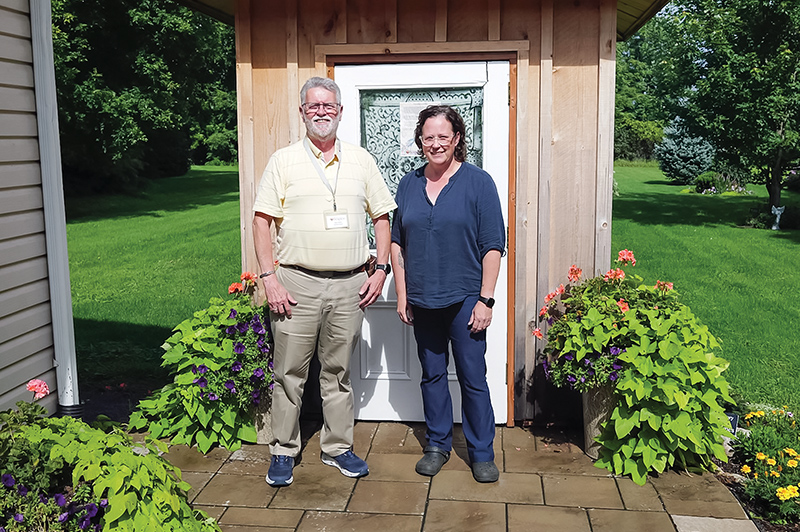
Steve Walsh, Executive Director and Jen Pretty, Program/Volunteer Coordinator with the “Wind Phone”, a tool that many have found useful in the complicated act of grieving. Tinkess Photo
WILLIAMSBURG – When most people hear the word “hospice,” they may picture a quiet facility with private rooms, nurses and doctors caring for people in the final stages of life.
Dundas County Hospice is somewhat different, according to Executive Director Steve Walsh. The organization’s philosophy is that palliative care is about living, not simply dying.
“I would say the primary thing is about quality of life,” said Walsh. “That’s absolutely key to us. A lot of people, when they hear the word hospice, they think about dying, and that’s not what we’re about. I mean, obviously we are there for clients who are at the end of life. But we’re all about improving the quality of the life that they have.
“Even if you look at things like our men’s shed, those are about improving the quality of life, right? And our grief groups improve quality but lend support as well. I think support is a big deal, because people are working through very difficult times. The idea is that we want to be there to support them in those times.”
Located on County Road 31 (Bank St.) in Williamsburg, the organization is a visiting hospice, meaning it does not operate a residential facility. Instead, its staff and trained volunteers bring support to people in their homes and other community settings.
Founded in 1992, Dundas County Hospice provides services at no charge to eligible residents of North and South Dundas. Its focus is helping people living with life-threatening or life-limiting illnesses and supporting their families and caregivers.
In that time there have some things that have remained the same, but many that have grown, according to Program/Volunteer Coordinator Jen Pretty. “I think a lot of things have grown,” said Pretty. “Our grief improvement program, for example, has grown exponentially. We are, I think, making great ways into getting the community to help them understand what we’re about. We are trying to just get us out there more, I think. People understand that we’re here for anybody who needs support.”
People can receive support at different stages of a serious illness. Volunteers can provide companionship and emotional support in a client’s home, while also offering caregivers an opportunity to take a break. Support may also be provided in hospitals, long-term-care facilities and other settings.
The hospice also operates an equipment loan program, providing items such as walkers, wheelchairs, bath seats and lift chairs to help people remain safely and comfortably at home.
“We’ve had our equipment loan program in place for quite a while,” said Walsh.” We’re supported by both the Township (North Dundas) and the municipality (South Dundas), right? They fund that. And, you know, some days we’re incredibly busy with that. Some of it may have to do with ageing demographics; more people going for knee operations, more people going for hip operations. But that being said, there are also young people that come here because they’ve had, you know, an accident or whatever. I think that’s something that’s growing as well.
For those who are able to get out, the hospice’s weekly Day Program offers another important service. Participants living with life-limiting illnesses can spend time with others in a supportive environment and take part in activities such as crafts, games, music, gentle exercise and meditation. Lunch and snacks are provided, and transportation can be arranged when necessary.
One point worth noting is that the emphasis is not solely on the person who is ill.
Dundas County Hospice recognizes that family members and caregivers can also face tremendous emotional and physical pressures. Support and respite services are available, along with opportunities to connect with others experiencing similar circumstances.
“We offer our caregiver support, on the first and third Tuesday of every month,” said Pretty. “Everybody’s welcome, it’s great for anybody who’s offering care to someone they know.”
Hospice support does not necessarily end when someone dies. Bereavement services are available to family members, friends and others coping with the death of someone close to them. Individual and group support can help people navigate the difficult period that follows a loss. They also know that people grieve in different ways, which is why they have so many different programs. They look at grief as having complications and that it’s a journey, not a problem to be fixed.
An interesting, and popular option that many have found helpful is the wind phone.
“Essentially the idea is, as you say, you go into it, there’s a telephone there,” said Walsh. “It’s connected to the wind, right? And you can come in and talk with someone who has passed, to resolve issues or just to speak your mind. There’s also a box in there where if you feel comfortable writing something as well and drop it in the box.”
The organization is funded through a combination of government support, donations, fundraising and grants, allowing its services to be offered without charge. They acknowledge that they are a part of a very generous community.
Still, there are always needs, a wish list if you will. “I think we’re in a situation now where we’re at capacity in terms of offices and in terms of space,” said Walsh. “If suddenly the “money fairy” showed up, I think we would look at either increasing the size of this facility or building a new facility. I think long term; we would all like to have a residential facility similar to Cornwall or to the hospices in Ottawa. But, you know, given the cost of buildings that is definitely a long-term vision. I think in the short term, we’ve got a land use committee now that’s looking at what we’re going to do in the future. I certainly hope they come up with some great ideas because as somebody who’s involved in the tactical side, I need to try to make decisions now based on what they want to do in the future.”
‘Also, we’re always looking for volunteers,” added Walsh. “Volunteers are so important. They’re the lifeblood of the hospice. There’s a very small staff here and we have a lot of clients. I think we’re always wishing for that new volunteer to come because believe me, there are lots of places they can help us out.”
As they head into the fall, Dundas County Hospice has several activities coming up. Their men’s shed takes place on Sept. 1. It gives men a chance to gather and just talk and see where the conversation takes them.
On Sept. 12 their Golf Tournament takes place at the Morrisburg Golf Club (Check in starts at 8:00 a.m.). They are also holding a movie night on Sept. 10 at the Old Town Hall in Winchester. Doors open at 5:30 p.m. and the movie starts at 6:00 p.m. Admission is free and the movie is “The Leisure Seeker.” In December they will hold their annual Memorial Tree lighting.
Perhaps the most important thing to understand about Dundas County Hospice is that it is not primarily a place, it is a community service. There are no rows of hospice rooms in Williamsburg. Instead, its reach extends into homes, hospitals, long-term-care facilities and the community.
Its building may provide a home base, but the real work of Dundas County Hospice happens wherever people and families need someone to walk alongside them during one of life’s most difficult journeys.
For more information on Dundas County Hospice, you can visit their website at dundascountyhospice.ca, or call them at 613-535-2215.
If you would like to have a light shined on your business, please contact us at: editor@etceterapublications.ca or call us at 613-448-2321.
Terry Tinkess is a professional photographer, educator and journalist. He has been making a living with a camera and keyboard since 1999 and has been featured in such publications as The Ottawa Citizen, Cornwall Standard Freeholder, The Globe and Mail, The Miami Herald, Ottawa Construction News, The Ontario Construction Report, Ontario Home Builder Magazine, Reed Construction Data, Canadian Potato Business and most recently, The Record and Eastern Ontario AgriNews. Terry lives in Morrisburg, Ontario with his wife Brenda, Mia the anxious Pittie and cat Chubbers.