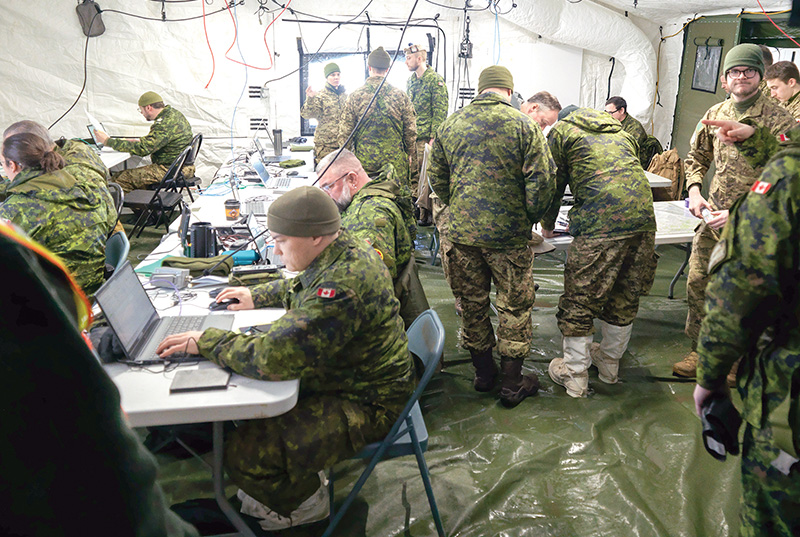
The Tactical Operations Centre (TOC) was a beehive of activity during the Ex Trillium 2026 exercise. Tinkess Photo
CORNWALL – Imagine if you will that our area was hit by a winter storm of epic proportions, a combination of heavy snow, ice, high winds, and blizzard conditions. Everything would grind to a halt, but being Canadian, we know we can hunker down inside and wait for the worst to pass, then the power goes out.
If you live in an urban setting, you should still have running water, and if you have a gas stove or wood burning appliance you’re still going to be okay in the short term, but what if you live in a more rural setting? If you’re on a well, no hydro means no water for drinking, cooking, washing or even to flush the toilet, and limited possibilities for heat. As well if you have a sump pump, it means water could start rising in your basement. You believe your local government and utilities will be working to resolve this problem, and for most of us, at this point, it is still just an inconvenience, but what if the power outage lasts for days, or weeks?
Then there is also a report of a train derailment, with rail cars containing chemicals rupturing and some of them on fire. What happens now?
To understand what needs to be done in extreme situations, the people we trust to ensure our safety practice different scenarios so that in practice they can identify what they are doing well, what they are doing poorly, and what they need to do to be prepared.
Such a simulation occurred last weekend in and around Cornwall. The exercise bore the name Ex Trillium Response 2026, and involved:
- The Counties SDG
- Township of North Dundas
- Municipality of South Dundas
- Township of North Stormont
- Township of South Stormont
- North Glengarry
- South Glengarry
- The City of Cornwall
- Cornwall SDG Paramedic Service
- OPP
- Eastern Ontario Health Unit
- Emergency Management Ontario
- CN
- Canadian Red Cross
- 33 Canadian Brigade Group
- Government of Canada
For this exercise the timeline was that the storm began on the afternoon of Jan. 25 and continued into Jan. 26. With the conditions listed above, many local municipalities declared a state of emergency, and with provincial resources stretched to their breaking point, the province requested assistance from the federal government in the form of a large, organized workforce. Historically, that has meant the military.
By the 28th, the provincial request had been approved and the many moving parts leapt into action and orders were given to mobilize for a deployment to the area, with the armories on Fourth St. East in Cornwall selected as a base of operations.
Then, to add another element, the scenario reports a train derailment northwest of Iroquois, in an area that is difficult to reach in good conditions. This triggers a response from South Dundas Fire, who invokes the Mutual Aid agreement they have with neighbouring municipalities and the involvement of CN and a Dangerous Goods Officer (DGO) and the expertise of the Eastern Ontario Health Unit.
Evacuation and shelter in place protocols are implemented, staging areas are established, and the questions, which by now are flooding in, are answered.
For these exercises to provide the greatest value, they need to be as realistic as possible, and anyone who has actively participated in one will tell you that an adrenalin rush and increased heartrate are not unusual. It feels real.
On Sat., Jan. 31, as part of the exercise, a mock press conference was held at the SDG County building on Pitt St. and members of the local media were given the opportunity to ask questions of the various partners to the exercise, just as they would were it a real event. Full disclosure: the media were given a summary of the scenario from which to formulate questions. In a real event, they would have to obtain this information from trusted sources and from their own resources and investigative methods.
At the completion of the event the media were able to ask questions about the exercise itself and what the various partners had learned.
South Dundas CAO Ben de Haan was the first to speak. “I can start with how busy it actually is, like it’s amazing, how good of a practice is, to be able to start coordinating between all the groups that have gathered here. Our role, the CAO’s role, you’ve got a couple more in the back, is kind of managing the operation center, and how interesting and busy and you are stretched being able to help facilitate stuff. That’s kind of from the upper level. Tim, Jamie, I don’t know if that kind of… would you add to that?”
“I guess my comment would be that even in a mock exercise, you feel the stress and anxiety around you while trying to play out the scenario,” said South Glengarry CAO Jamie Fawthrop. “It does really emphasize that the importance of practicing this exercise and preparing ourselves because in the event of a real emergency, just trying to imagine how stressful and anxious we would be in that scenario. I think the more we do practice it, the better we are going to be if, and when something, the real incident, occurs.”
Counties Councillor Jason Broad, who is also the Mayor of South Dundas added that it is more than just practice.
“Last night, when we talked about the info, and I started to read the data, and then when Lachlin McDonald (Counties Councillor and Mayor of South Glengarry) and I got together this morning, we started reading every detail from what the team did last night and this morning. I was totally consumed, as credit to you guys that felt like a real press conference, like it felt real, which is my point of Jamie talking about practice.
“I was talking this morning, not only practice, but perfect practice, right? So, you know, people say practice makes perfect, its perfect practice makes perfect, right? So, these are the opportunities that we need to take, and we do and we do smaller ones in a municipality. And I’ll give a shout out to Mayor (Tony) Fraser with the Alvin Runnalls forest fire recently, where it was a real state of emergency, and watching him, and watching all his video posts and all the updates. It’s critical to practice. I think this is a great event to bring us all together to do that.”
Colonel Finn Mullally is the commander of 33 Canadian Brigade group, which is colloquially known as the wolf pack. Their area of operations runs from Timmins to Sault Ste Marie to Cornwall to Oshawa.
“There’s also a kind of a serendipity between the exercises that we run within the division,” said Colonel Mullally. “So, within Ontario, we practice our own emergency response to domestic operations on an annual basis. And we had some work done last year between ourselves and SDG, so it was natural, this desire last year to build on that this year.
“There was joint planning of this, of this exercise, particularly the scenario, has been worked on for about nine months, from my chief planner, who happens to be a local, a local Cornwall resident as well, and so Trillium Response is actually the military name of the series of three exercises that we do across Ontario. And so, there was a nice serendipity there between what we were going to do anyway, and we kind of put our put our resources together.
Todd Lihou, SDG Corporate Communications Coordinator explained that in this exercise the decision was made to try a slightly different approach. “One of the things we’re really trying to exercise is we’ve never done a Regional Emergency Operations Center (EOC) before. Typically, when we’ve done these exercises, we’ve kind of had it very centralized to that particular municipality. And as you can see, we’ve got a bunch of different people in the room. And what we’ve tried to build into this is, how do you hand off information from one group of individuals to another so we can continue moving the ball down the field?
“Last night, all of these people were different,” continued Lihou. “They all had different folks in different roles. And part of the strategy and part of the planning is to have them come in at the beginning of the shift and read some of the materials that took place the shift before, liaise with those people, ask them questions about what they were doing. So that way they can kind of take that ball and carry up the field. Because, as you know, emergencies don’t run nine to five, and typically they take a long, long time to administer. So that’s why we’re kind of exercising with that, bringing in different folks and four-hour increments to kind of expose them to as much reality as possible.”
At the conclusion of the press event, media were allowed to visit the Armory for a first-hand look at the command centre which had been established there to house the 120+ members of the military who had been deployed there.
The tour of the Fourth St E camp highlighted the logistical and operational capabilities of the Canadian Armed Forces. Key points included the use of a mobile kitchen trailer to feed over 100 soldiers, the deployment of heated tents for up to 130 personnel, and the importance of acclimating soldiers to extreme weather conditions.
The camp also featured a modular tent system, a headquarters shelter system, and a tactical operation center. Captain Cody Van Loon, a local resident and platoon commander, discussed the role of the people he serves with in the exercise.
Regardless of where we respond, and other tbgs (territorial battle groups), other brigades and divisions are doing their own sets of exercises. So, no matter what, we’re always exercising our capability, whether it be, you know, at home here in our own backyard within the SDG counties, or in Ottawa or Sault Ste Marie to North Bay, anywhere of the sorts, we’ve maintained that capability, and we’re able to do this type of exercise and enjoy doing it no matter where we are.”

Terry Tinkess is a professional photographer, educator and journalist. He has been making a living with a camera and keyboard since 1999 and has been featured in such publications as The Ottawa Citizen, Cornwall Standard Freeholder, The Globe and Mail, The Miami Herald, Ottawa Construction News, The Ontario Construction Report, Ontario Home Builder Magazine, Reed Construction Data, Canadian Potato Business and most recently, The Record and Eastern Ontario AgriNews. Terry lives in Ingleside, Ontario with his wife Brenda, Mia the anxious Pittie and cats Wally and Chubbers.