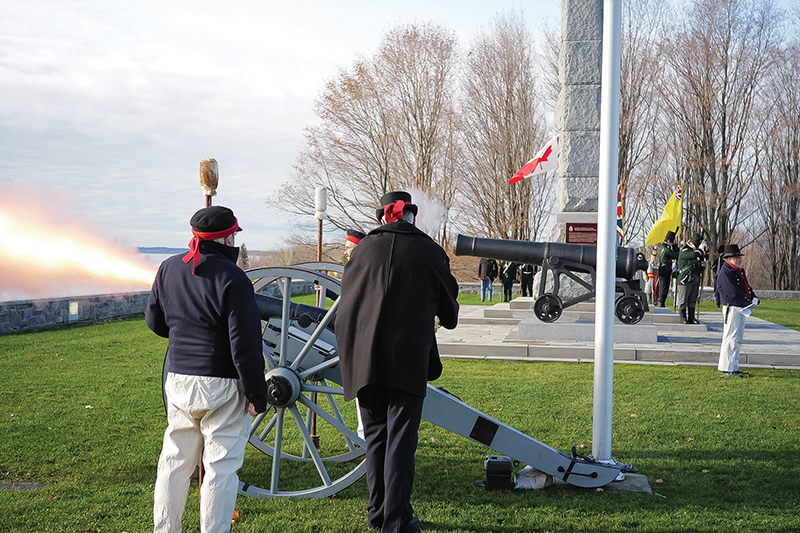
On Nov. 11, Canadians honour those who made the ultimate sacrifice in defence of our freedoms. Just east of Morrisburg, a unique ceremony remembers those whose sacrifices helped make Canada the country it is today. Seeing this one small cannon belching smoke and fire helps to imagine the conditions that existed for hours on Nov. 11, 1813, as the future of Canada hung in the balance. Tinkess Photo
MORRISBURG – On Nov. 11, Canadians from coast to coast to coast gather to remember those who made the ultimate sacrifice in defense of those beliefs which we hold dear.
Just east of Morrisburg, however, is a unique ceremony which remembers those, without whose sacrifice, Canada as a country might not even exist.
The ceremony takes place annually at the Crysler’s Farm Battlefield Memorial. Shortly before 9:00 a.m. a small crowd made the walk up the hill to await what, in the current political climate, is a very timely act of remembrance. On hand for the ceremony were Stormont, Dundas and Glengarry MP Eric Duncan, Stormont, Dundas and South Glengarry MPP Nolan Quinn, SDG Warden Francois Landry, and South Dundas Mayor Jason Broad.
The actual ceremony was similar to most Remembrance Day Ceremonies, but different in that it focused on specific battle, the battle of Crysler’s Farm which took place on Nov. 11, 1813, during the War of 1812.
The battle occurred during an American military campaign intended to capture Montreal, a strategically important objective. American forces, numbering approximately 4,000 men, travelled down the St. Lawrence River from Sacketts Harbor in a coordinated operation involving troops moving by land and water.
A British force of approximately 1,200 soldiers, consisting of British regulars, Canadian militia and Indigenous warriors, was positioned near Crysler’s Farm, close to present-day Morrisburg.
On Nov. 11, American troops under the command of Brigadier General John Parker Boyd encountered the British force, commanded by Lieutenant Colonel Joseph Morrison. Morrison’s troops were significantly outnumbered, but they occupied advantageous defensive ground and used disciplined infantry tactics and artillery to repel repeated American attacks.
The fighting lasted several hours, with both sides suffering casualties. The Americans eventually withdrew, leaving the British in control of the battlefield.
The victory effectively ended the American campaign to capture Montreal in 1813. Combined with the American defeat at the Battle of Châteauguay on Oct. 26, 1813, it prevented the Americans from gaining control of the St. Lawrence River corridor and significantly weakened their efforts to conquer British North America.
The ceremony included readings and speeches from several people with a personal connection to Crysler’s Farm. The War of 1812 prayer was read by Sperry Lee, President of the Friends of Crysler’s Farm Battlefield. This was followed by a cannon salute, a moment of silence, the Piper’s Lament by Pipe Major Hugh Metcalfe, Royal Canadian Legion, Kemptville Branch 212. This was followed by a second cannon salute, the laying of wreaths, and in closing, “When the Battle is over” played by Pipe Major Metcalfe. A short period of refreshments and comradeship followed the ceremony.
Today, as we experience disrespect and intimidation from our closest neighbour, perhaps it is very important for both countries to remember that once upon a time a force superior in numbers discovered that imposing their will on those on the north shore of the St. Lawrence River might not be as easy a task as they might have believed.
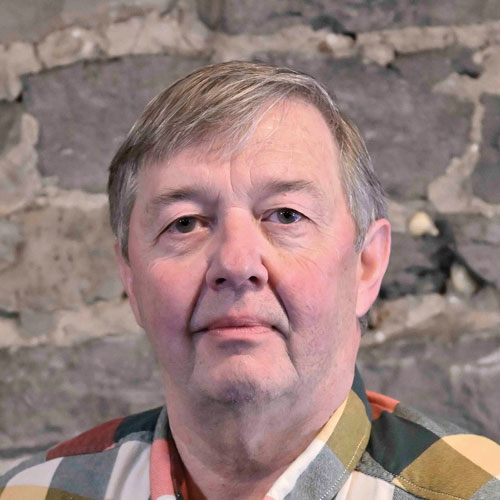
Terry Tinkess is a professional photographer, educator and journalist. He has been making a living with a camera and keyboard since 1999 and has been featured in such publications as The Ottawa Citizen, Cornwall Standard Freeholder, The Globe and Mail, The Miami Herald, Ottawa Construction News, The Ontario Construction Report, Ontario Home Builder Magazine, Reed Construction Data, Canadian Potato Business and most recently, The Record and Eastern Ontario AgriNews. Terry lives in Morrisburg, Ontario with his wife Brenda, Mia the anxious Pittie and cat Chubbers.