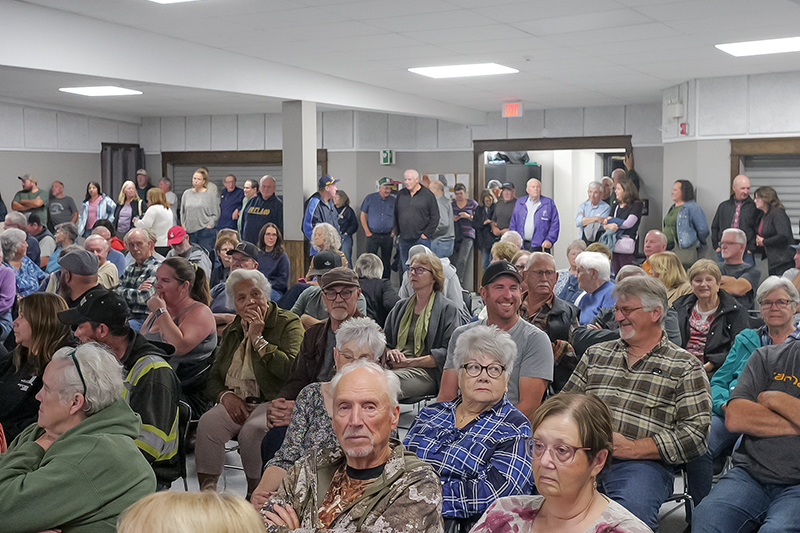
Approximately 300 people packed the Joel Steele Community Centre on Thurs., Oct. 1 for the North Dundas All Candidates meeting. By the time the North Dundas All Candidates meeting started, it was standing room only. Tinkess Photo
WINCHESTER – A crowd of approximately 300 crowded into the Joel Steele Community Centre on Thurs., Oct. 1 for the North Dundas All Candidates meeting, hosted by the Dundas Federation of Agriculture (DFA).
The event featured all eleven candidates who are running in the current election.
- For the position of Mayor: Tony Fraser and Theresa Bergeron
- For the position of Deputy Mayor: John Thompson and William Healey
- For the position of Councillor: Michael Erickson, Peter Guy, Matthew Uhrig, Jordan Alexander Hodge, Cory Houle, Edgar Ramirez Aguilar, and Gerald Jaquemet
The evening started with Owen Short, one of the organizers thanking the DFA for sponsoring the event and then acknowledging the candidates. “Thanks definitely need go to the eleven people who sit in front of you,” said Short. “These individuals have offered to represent our township with the difficult task of decision making, especially when we are all so divided in our wants and needs.”
Short then went on to introduce the moderator, Jackie Pemberton, who explained the format that would be used.
“So tonight we have a clear objective, to give our community a chance to hear visions and goals of our five council positions, to ensure everyone is heard fairly and that we strictly adhere to the following format:
- The order of speaking for introductions was selected prior to the meeting
- Each candidate would have a maximum of three minutes to introduce themselves and outline their vision for the community
- Following the introductions two questions would be asked on behalf of the DFA
- The meeting would then be open for questions from the floor
- Each person must identify themselves and will have one minute to ask their question and can choose which two candidates should answer
- Each candidate has two minutes to respond
- To allow as many as possible to ask questions, no rebuttals or follow-up questions would be allowed unless you went to the back of the line to await a second opportunity
Pemberton cautioned everyone in attendance to act appropriately. “To maintain a productive evening, I ask everybody, both candidates and audience members to treat each other with the utmost respect and courtesy. We’re all here because we care about the future of North Dundas, and a great discussion relies on mutual respect.
“I will say that to ensure that we’re safe and for the dignity of everyone, there will be no outbursts, booing, personal attacks, or defamatory comments. You’ll get one formal warning to stop, and if you choose not to do so, then you will be asked to leave immediately.”
At least three members of the Ontario Provincial Police were present at the start of the meeting in case they were required.
With Vince Zandbelt controlling the time, the candidate introductions began.
If you have followed municipal politics, the speeches were pretty much what you would expect, with few surprises, although Fraser announced that he would be retiring from Lactalis and would be able to fully focus on the role of Mayor if re-elected. Each candidate spoke of their experience, or if they were new to municipal government their willingness to listen to constituents, ask questions and look for answers, and in some cases to fix what they felt was broken. Each candidate received polite applause, some more than others, but all were treated with respect.
Then came the Questions from the DFA.
The first question was to Tony Fraser and Will Healey, and it concerned the importance of roads and bridges in the township and how they would balance the municipal budget while at the same time maintaining the roads and bridges for heavy, wide agricultural machinery.
Fraser answered first and advised that the previous method of double service treatment (tar and chip) was not as good as it had been years ago, so they were now building a better base with asphalt (hard top) finish. It is more expensive but stands up better and that for the needs of the area, it was necessary.
“We can invest the money necessary to ensure that we have a process, a plan, and we can evaluate that and adjust our tax rate to make sure that we get around and looked after the roads that support agriculture,” said Fraser. “Almost every road outside of the village supports agriculture.”
Healey agreed with much of what Fraser said, adding that the equipment 20 years ago was also much smaller and lighter. He stressed the need for a long-term plan. “Our traffic patterns change and things occur. The most important thing we can do is focus on a long-term plan, plan the roads that have the highest amounts of traffic, continue to redevelop those in a timely and efficient manner, and work our way out of the township on smaller roads with smaller amounts of traffic. The township has done a great job in the road study that was presented at council last year, and it identifies a lot of those areas where we need to focus and there’s more room for more focus as we continue to find additional resources and develop and make partnerships with local businesses.”
The next question was for Theresa Bergeron and Cory Houle. They were asked “What is your exact stance on tree cutting, land clearing, and tile drainage in North Dundas? And if elected, would you commit to protecting agricultural exemptions under local bylaws so that farmers can bring historical acreage into production without being buried under costly municipal red trade restrictions?”
Bergeron, who has spoken against clear cutting and in favour of increasing the canopy took a moment before answering. She started by stating that there was land that was rocky and couldn’t be cleared. She then continued to explain the need to balance the ability to clear land with the need to ensure the long-term health of the aquifers.
“We have bogs that we require for our aquifers,” said Bergeron. “The bogs need to stay there because if we don’t have bogs, we’re not going to have water in our wells. The issues that we’ve had with water, and these are facts, is that we have climate change, and the aquifers are not getting as much water as they should.
“And so, I don’t think there’s much trees left to cut down in North Dundas,” continued Bergeron. “There’s, I think, we’re only at 5 per cent right now for tree cover. And whenever we consider a clear cutting and tile drainage, at the same time, we have to consider, our water, we have to balance the two. That’s the thing: We have to balance the two because both are connected and people may not realize that, but it is.”
Cory Houle explained that because of his employment as an Engineer with a consulting firm involved in land use planning, he had a good understanding of how everything is connected. He acknowledged that in the farming community, “your land is your land.”
“So, you want to be able to do what you can do with it, but you have to understand we also have to work together to make a sense of taking into account drainage and wind and how it affects roads and everything.
“So, what I would suggest is working with farmers, having them at a table as we’re planning, doing long term planning around roads and infrastructure, and understanding what their plans are, with their land, and working together to make sure that everything is working in conjunction with each other.”
Next came the questions from the floor, which started slowly, but moved smoothly, with bits of humour here and there. Questions ranged from how to make the process for volunteers to organize events within the township, to changing the time of Council meetings so that more people could attend, to the very important question of how the fire department could get the specialized training and equipment they need to perform high angle rescue (as when a person becomes trapped in a silo.) Some questions involved personal grievances, while a couple had obvious personal undertones which were poorly hidden. Even so, everyone in attendance could, for the most part be acknowledged for “taking the high road.”
There was one contentious question, however, which seemed to illustrate how, in the age of social media and a lack of clear information, a story can take on a life of its own, particularly when it involves missing money.
The question was “Theresa mentioned before, we’re small tax based. We have big expenses, but a small tax base. So, when money goes missing in the township, and we all know we’re talking about is the roof in this arena. If elected, what steps do you take to find the money and hold people that lost it accountable? The question was first, mistakenly asked of Fraser and Michael Erickson, but corrected to Erickson and Peter Guy.
Erickson was the first to answer. “I mean, obviously, if there is money that’s missing and it’s gone through a fraudulent way, then the natural path to take is to find the people that are responsible.
And, I mean, I don’t know if the township would be willing to hire lawyers and go so far as to press criminal charges, but, I mean, that’s a pretty serious accusation and a pretty serious situation to be in.
I’m not privy to whether or not the $260,000 was in fact lost or just vanished into thin air. I don’t know where it went. I have heard rumours, but I’m not going to comment on the rumours. Yeah, you know, if it gets to a point where there has to be a complete audit, then if elected, then I would call for a complete audit.”
Peter Guy then offered his response. “… as far as talking, Brody, you got to watch what you say, and where you say it, and how you say it. And… I think that’s something for new council. I talked about it, and with the township staff, just the last week or so, lots of questions about it. I never really got told a lot. I know another member that’s running, inquired about it, too, never got much response, so that would be my priority if I get elected. Check that out, when new council gets in, that’s one of my first priorities just to check that out, and I got about four or five other things that I think new council needs to address before the township moves ahead.” He received loud applause from a portion of the audience.
A few questions later Amy Fraser, Tony Fraser’s wife, came to the podium and asked a question of Tony and Theresa. “My name is Amy Fraser, lifelong resident of North Dundas, and I have a question for Theresa and Tony, and if you could please explain to us, as Jamie’s alluded to the missing money, and to your answer to that question?
Theresa Bergeron was the first to respond. “That actually was talked about in our last council meeting, but we only usually have two people that show up at our council meetings, and so in a lot of people, well, hardly anyone watches it streamed. So, there was not $260,000 lost. What happened was there was a study that was started to cover five recreational buildings in order to get funding from the province, uh, you know, for a new roof or upgrade our buildings. Part of that process was hiring a company that would do studies, engineering studies, of the structures of the buildings, what they needed, so forth. And part of that was, with every step of these studies that was done, the province would give us money. So, the province ended up giving us $197,000.
Meanwhile, the fellow or the company that was supposed to do the whole studies, the linear studies, well, he didn’t finish. Let’s put it that way. And so, what we were wondering for a while was, will the province want their money back? Do they want their $197,000 back? And so, it took a few, I think it started in 2022 or 2023. So, what happened? With time, we tried to sort it out. And so, it… Anyway, it ended up that if we found someone to finish the study, we would not have to give the money back. So, we found someone else who finished the study. So, we did not lose that $197,000. Now, initially, the whole study was costing the taxpayer something like $70,000 for the tax base.”
At that point Bergeron’s time ran out, and Fraser continued the explanation, and wasn’t completely successful in hiding his frustration.
“We entered into an energy savings audit, looked at every opportunity to find savings through energy efficiencies,” said Fraser. “There’s a green audit. That’s a report that’s going to go on the shelf. There’s going to be a $260,000 report that goes on the shelf. So, whenever there’s an opportunity to seek grant funding, we have the shovel ready information for savings.
“People think that you can put a roof on this building for $300,000, they are absolutely insane. Those people that are perpetuating that line, you cannot do it. It’s a very expensive project, and if we can find great savings through a report that identifies energy savings, that is appreciated by the province and the federal government when they dole out grants, because they approve the people that perform these odd reports, we will find savings. It’s talked about many times here about the savings we had.
So, $260,000, the numbers that the deputy mayor speaks about is accurate. The tender will finish the project; there will be a savings of $20,000. So, at the end of the day, the taxpayer is going to pay about $65, $66,000 for a $260,000 report. Great savings. That’s where the money went. I’m hoping that the deputy mayor’s thoughts and my thoughts can put to bed the lie that’s being expressed, that people come up in the microphone and talk about it. People sit at our council meetings and have heard it. They do not like the truth. They like you spin stories.”
There were both boos and applause when Fraser finished speaking, and the audience as a whole was cautioned by the moderator.
For anyone who is interested, the matter is explained in item 6 (1)b on the agenda for the Sept.16 regular North Dundas Council meeting. The full report that was submitted is on page 42-43 of the agenda and can be viewed on the Township You Tube channel.
The remainder of the meeting progressed without any topics as contentious being discussed.
With less than three weeks until election day there is still time for every eligible voter to dig a little deeper and ask a few more questions before making their decision on Oct. 26, or at one of the advanced polls. Having a turnout like this is a great first step, but it needs to continue right up to the polling station where hopefully a clear majority will choose wisely, basing their decision on facts, not social media rumours, whoever they vote for. It is the least any community deserves.
Terry Tinkess is a professional photographer, educator and journalist. He has been making a living with a camera and keyboard since 1999 and has been featured in such publications as The Ottawa Citizen, Cornwall Standard Freeholder, The Globe and Mail, The Miami Herald, Ottawa Construction News, The Ontario Construction Report, Ontario Home Builder Magazine, Reed Construction Data, Canadian Potato Business and most recently, The Record and Eastern Ontario AgriNews. Terry lives in Morrisburg, Ontario with his wife Brenda, Mia the anxious Pittie and cat Chubbers.