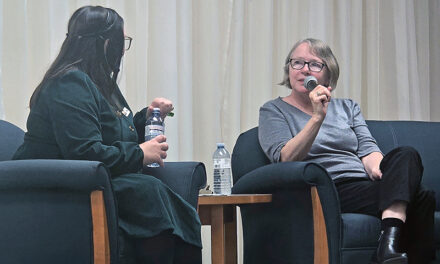

For the second consecutive year the Morewood Recreation Association hosted a day of Truth and Reconciliation, in support of the National Day of Truth and Reconciliation, which takes place on Sept. 30. Seen above, Grand Chief Leonard Lazore has a very approachable demeanor that immediately gets your attention and makes you want to listen to what he has to say. Tinkess Photo
MOREWOOD – What does the idea of Truth and Reconciliation mean to you? For a simple and antiseptic meaning you could look up the two words in the dictionary and learn that truth involves conforming to reality, honesty and verifiable fact. Reconciliation involves the restoring of friendly relations, making opposing ideas compatible. No mention is made about healing, learning, understanding and acceptance, although these terms play a very important role if Truth and Reconciliation is to be more than just words. There must be actions as well.
That is what has happened in the village of Morewood last Saturday. For the second consecutive year the Morewood Recreation Association hosted a day of Truth and Reconciliation, in support of the National Day of Truth and Reconciliation, which takes place on Sept. 30. Commonly known now as Orange Shirt Day, it, and related events force us to take a good close look at things like residential schools, The 60’s scoop, and the multi-generational harm that occurred because of these actions. But while you need to accept what happened in the past, you also need to take steps to move forward, and that involves healing, which is what the Morewood event has tried to accomplish.
“I live here, and I’m First Nations,” said Stephanie Scott, one of the event’s founders. “And I don’t really have any people representing me or my culture. There’s also a lot of stigmas and questions coming towards it, and people don’t feel they can attend or that they can be part of it.
“So, we kind of wanted to bring it out to the rural area where we both live, to let everyone know, it’s for everybody. You’re welcome, whether you’re indigenous or non-indigenous. Also, one of our biggest things was that a lot of people who can’t drive or don’t like big crowds, they tend to miss out on stuff that goes on in Cornwall or Ottawa. At least if it’s in the community, somebody can get them here if they want to participate.”
Do they think it is making a difference?
“We’re getting more people coming up and saying, this is amazing. You know, we’re so happy to see this. How did you even think to do this,” said Stephenie Shannon. “And it definitely generates conversation, so I think we’re moving in the right direction.
There was a full day of activities in and around the Morewood Community Centre, starting with a talk and traditional smudging ceremony with Vincent, a First Nation’s elder. This was followed by an interactive presentation by Grand Chief Leonard Lazore of the Mohawk Council of Akwesasne.
Anyone who attended the event last year may have returned simply for another opportunity to listen to Grand Chief Lazore, who is an extremely engaging person, the kind of person who can speak with people with opposing viewpoints and help them to find a common ground. He frequently uses the phrase “different, not better,” in describing different cultures, presenting examples and then letting people come to their own conclusions.
With the help of those in attendance, Grand Chief Lazore illustrated the difference between a culture that is based on the concept of a collective community and one that is based more on individuality.
“I wanted to do something different for you today, and today we’re actually going to, I’m going to show you two different worlds,” said Grand Chief Lazore. “I’m going to show you a different world, and again, these different worlds, there’s a lot of value, you’re going to see, but you’re actually going to feel the differences in these worlds. There are two different worlds they’re going to show you.
“With that being said, I mean, no disrespect, they’re just different worlds. And we’re going to do an activity today. We’re going to be coming up here, we’re going to be standing in certain circles, and there’ll be a little bit of light walking and standing, and now, if you need to bring a chair to your circle, then you can do that. That’s fine.”
The Grand Chief then went on to illustrate first a community-centric culture, where different generations played different roles but how they all combined to create a very strong, supportive community, and how events like the 60’s Scoop removed parts of one generation and as a result damaged members of other generations, causing substantial and long-term consequences.
He then illustrated a different, more individual-centric society, where generations were spread farther apart and how those who were closer to the “support services” may have done okay, but the farther removed you were from that, the less support you received.
Grand Chief Lazore, with a background in social service, clearly understands the concept of show, don’t tell, which makes the message easier to comprehend.
Throughout the remainder of the day attendees had the opportunity to listen to other speakers, to sample Indigenous cuisine, participate in interactive workshops and be entertained by a live Drum Circle, Traditional Dancers and a Hoop Dancer.
It was a busy weekend in North Dundas, with at least two other events running simultaneously, yet the crowd seemed larger in this the event’s second year. There seems to be a desire to learn, and a willingness to listen and ask questions and to try to understand, all of which promote healing, which is essential in moving forward. Acceptance and change seldom happen quickly, but events such as this encourage us to move in the right direction.
Terry Tinkess is a professional photographer, educator and journalist. He has been making a living with a camera and keyboard since 1999 and has been featured in such publications as The Ottawa Citizen, Cornwall Standard Freeholder, The Globe and Mail, The Miami Herald, Ottawa Construction News, The Ontario Construction Report, Ontario Home Builder Magazine, Reed Construction Data, Canadian Potato Business and most recently, The Record and Eastern Ontario AgriNews. Terry lives in Morrisburg, Ontario with his wife Brenda, Mia the anxious Pittie and cat Chubbers.