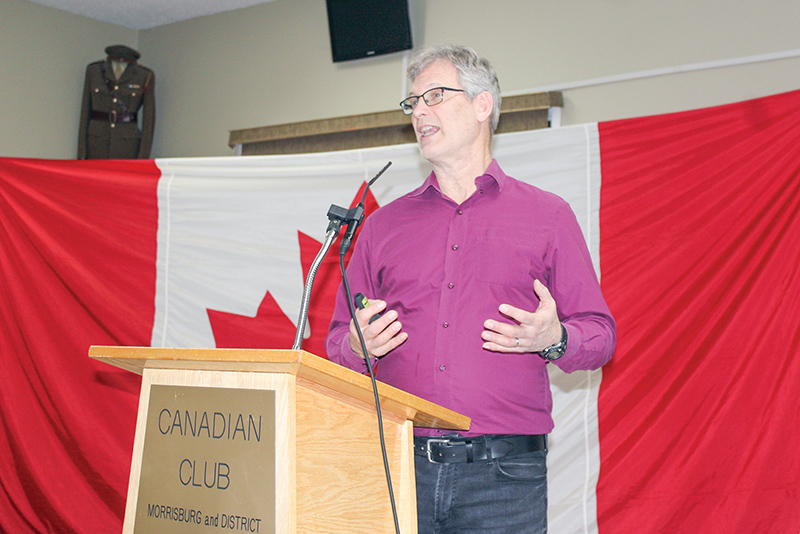
River Institute Executive Director Jeff Ridal is seen during his presentation to the Canadian Club of Morrisburg and District on the St. Lawrence River and the work by the organization to ensure it remains a viable waterway. Thompson Goddard Photo
MORRISBURG – There was a full house for the April 18 Canadian Club of Morrisburg and District meeting held at Royal Canadian Branch 048 in Morrisburg. Following a delicious meal, Jeff Ridal spoke on the St. Lawrence River. The topic of his one-hour presentation was that of “Communities for Rivers, Rivers for Communities”, which included a power point which augmented his informative and interesting presentation.
Ridal is the executive director of the River Institute, located in Cornwall, an environmental non-profit organization. The River Institute (R.I.) was established in 1994 as a non-profit organization with charitable status. The R.I. is dedicated to researching aspects of the St. Lawrence River, educating people about this gateway to the Great Lakes and reaching out to communities for partnerships.
He began by mentioning how the St. Lawrence and Great Lakes combined hold approximately 20% of the world’s fresh water, with over 60 fish species living in the waters of the Upper St. Lawrence River. He noted over the last decade there has been an increase in ecosystems pressures in the area as well as invasive species such as zebra mussels, carp and lamprey increasing.
According to Ridal, the changes in the St. Lawrence water system is due to several issues, including the construction of the St. Lawrence Seaway as well as the number and size of ships transversing the waterway. Change was also brought about by the emissions from industries located on the river’s banks prior to regulations about emissions beginning in the 1970’s. Some of the manufacturing companies contributing to the ecological issues in the past include Courtaulds and Domtar.
Research is an integral part of the work done by the River Institute. Ridal explained this research is dedicated to evaluating the health of the ecosystem of the river as well as to address concerns raised from the community about the state of small fish populations.
One of these programs is a study of environmental DNA found in the water samples. These investigations are being used to determine which fish have been in the water, resulting in one of the largest datasets on the Upper St. Lawrence River. There are studies underway which seek to determine the rate of shoreline erosion and its effect on fish populations.
The River Institute has a number of educational partners working with the organization in their research including community colleges, universities, conservation authorities, the Mohawk Council of Akwesasne and other community organizations. Ridal mentioned the building of EDA labs at St. Lawrence College as an important part of scientific research and collaboration with partners.
Community outreach and education are important aspects of the work done by the River Institute. He mentioned there is evolution in these areas, mentioning that the use of social media and peer review articles are useful. He spoke about educational programs both at the Institute or at the schools are important in teaching young people about the importance of this river.
Other examples of reaching out to residents include river-based festivals in local communities, involving the art community by displaying work inspired by the river, the hosting of a symposium on the St. Lawrence and for involving volunteers in shoreline cleanup and rehabilitation.
Following a short questions and answer period, Ridal was thanked and the evening drew to a close with the singing of our national anthem.
More information on the River Institute can be found on their social media pages and website located at https://riverinstitute.ca. Information on the Canadian Club of Morrisburg and District is available on their Facebook page and website which is located at www.canadianclubmorrisburg.com.
Carolyn Thompson Goddard, grew up in Chesterville and attended North Dundas District High School. After completing her BA in Political Science at Carleton University she has worked as a medical secretary and library technician. In 2020 she graduated from Algonquin College with a diploma in Journalism and has been a reporter and column writer for The Record for over 10 years.