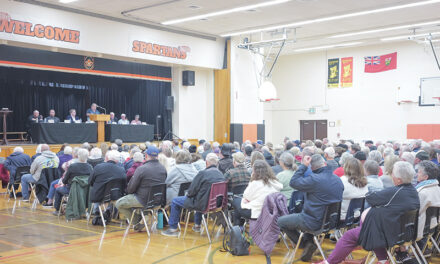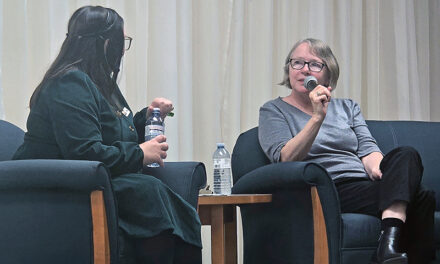
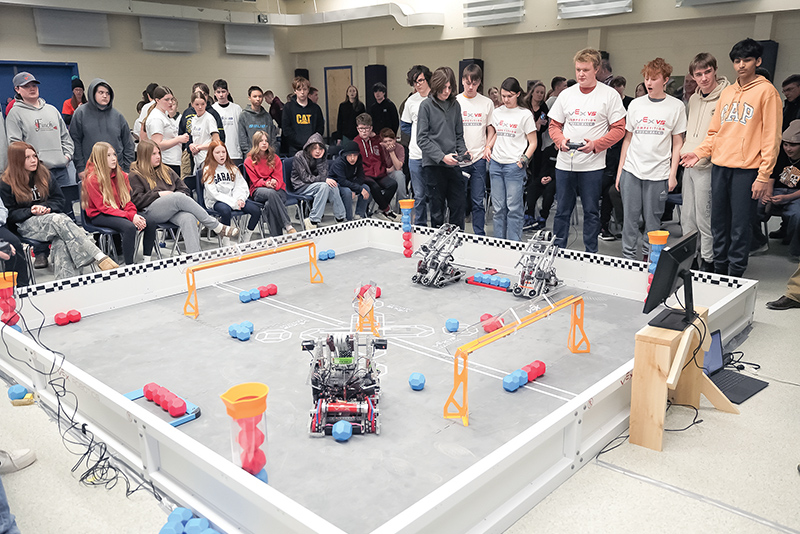
Students from across the Upper Canada District School Board (UCDSB)came together at North Dundas District High School (NDDHS) on March 4 for the board’s first VEX Robotics regional competition, showcasing months of design, programming, and teamwork. Shown above are students that came and went throughout the day, but there was standing room only while the competition was going on. Tinkess Photo
NORTH DUNDAS – Students from across the Upper Canada District School Board (UCDSB) gathered on March 4 at North Dundas District High School (NDDHS) for the board’s first-ever VEX Robotics regional competition, showcasing months of design, programming, and teamwork.
The event featured two separate robotics competitions: VEX V5 for secondary students and VEX IQ for students in Grades 7 and 8. Each competition included a different game and field design, but both challenged teams to build robots capable of driving, strategic gameplay, and autonomous programming.
Top honours at the event went to Brockville Collegiate Institute (BCI), who captured gold in the VEX V5 division and Glengarry District High School, who captured gold in the VEX IQ division. As winners of their divisions, both teams will now represent the UCDSB at the provincial robotics competition in Toronto May 4-5, 2026.
The competition itself was largely a student-led initiative and marked the first robotics competition hosted by the UCDSB. The event was made possible through the support of Andy Caruthers, UCDSB lead technology & design teacher and the robotics experience of NDDHS teacher Scott Currie. The competition introduced many participants to potential pathways in engineering, mechatronics, skilled trades, and technology-related careers.
Within North Dundas, Currie has been instrumental in developing this course of study and echoed the idea that much of what was happening was student led.
“Well, so this event, saying you have 18 schools from across the board, and this event has V5. So V5 robotics is for high school, from grade nine to twelve, and IQ is meant for grade seven and eight,” said Currie. “On all these teams in this whole term, this is all student run. I’m just mentoring.”
Many people, if you told them this competition was happening at NDDHS, a rural high school, dead centre in a farming community, they might wonder why the interest in such a STEM-centric (Science-Technology-Engineering-Math) program. Currie on the other hand sees it as the ideal location for such innovative learning. “If you look at the good farm industry, and you look at the students, that’s the leading innovation right there,” said Currie. “So, if you look at farming and robotics and coding, they’re doing that, that’s the world they live in. And now, as soon as we’re doing this in high school, it’s applicable outside of the school.”
Is it fair to say that the students begin to realize that even though they aren’t at a big city school in Toronto, or Ottawa, or London, that they can still get anywhere they want from right here?
“Absolutely,” continued Currie. “Prepare them for the future and the pathways open up. If you’re doing modelling and you’re doing design, and design is a real focus, and you’re using it as your driving force, then now you can start connecting pathways. You can go into skill trades, but then you can also go into other skill trades like engineering, encoding, and programming and technologists. Those are all connected.”
The event was held in the multi-purpose room, and it was a beehive of activity, but an expensive beehive. According to Currie, each of the robots would have cost in the area of $5,000, so if you do the math, 18 teams, each with a robotic player, and you’re approaching $100,000.
It’s expensive, but how does it compare to the cost of not preparing students, not giving them the skills they will need today and in the future?
One of the goals of an event like this is to prove that there is a lot happening in eastern Ontario, thanks to community partners, forward thinking educators who aren’t afraid to show initiative, and students who aren’t afraid to look into the future and take ownership of what they need to get there. What they can accomplish is amazing, and it is displayed in the results.
Secondary Division – VEX V5 Robotics
Six teams competed in the VEX V5 Push Back challenge, played on a 12-foot by 12-foot field. Alliances of two teams competed in matches that included a 15-second autonomous period followed by one minute and 45 seconds of driver-controlled play. Teams scored points by placing blocks in goals, controlling scoring zones, and parking their robots in designated areas at the end of the match.
Participating schools in this event included BCI, Carleton Place High School, NDDHS, Rideau District High School (two teams), and South Grenville District High School.
Final standings were:
- Gold – Brockville Collegiate Institute
- Silver – Rideau District High School (Team 2)
- Bronze – North Dundas District High School
Intermediate Division (Grades 7 and 8) VEX IQ Robotics
Ten teams competed in the VEX IQ Mix & Match challenge, played on a 6-foot by 8-foot field. Teams worked in alliances during 60-second teamwork matches, collaborating to score as many points as possible. Students also competed in robot skills challenges, including both driver-controlled and autonomous coding matches.
Participating schools included Almonte District High School, Athens District High School, Carleton Place High School, Char-Lan District High School, Chimo Elementary School, Glengarry District High School, Rideau District High School, St. Lawrence Secondary School, and Tagwi Secondary School.
Final standings were:
- Gold – Glengarry District High School
- Silver – St. Lawrence Secondary School
- Bronze – Chimo Elementary School

Terry Tinkess is a professional photographer, educator and journalist. He has been making a living with a camera and keyboard since 1999 and has been featured in such publications as The Ottawa Citizen, Cornwall Standard Freeholder, The Globe and Mail, The Miami Herald, Ottawa Construction News, The Ontario Construction Report, Ontario Home Builder Magazine, Reed Construction Data, Canadian Potato Business and most recently, The Record and Eastern Ontario AgriNews. Terry lives in Morrisburg, Ontario with his wife Brenda, Mia the anxious Pittie and cat Chubbers.