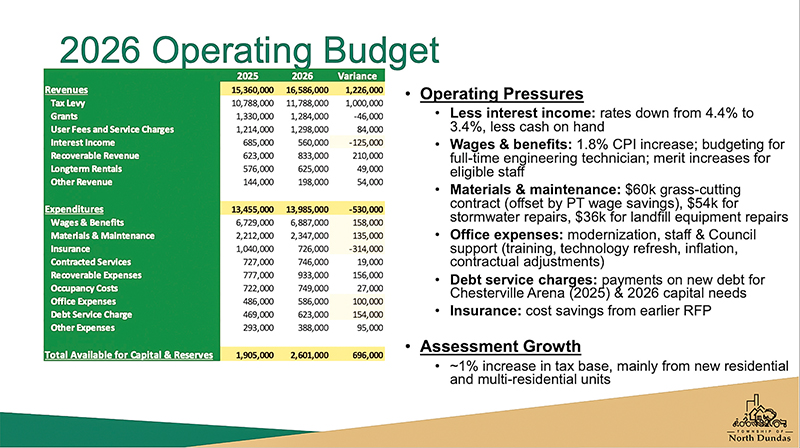
Graphic detailing the 2026 North Dundas operating budget. Township of North Dundas Courtesy Photo
WINCHESTER – Two matters dealt with by North Dundas Council at their regularly scheduled meeting on Dec. 17 were the water and sewer budget for 2026, and the adoption of 2026 Municipal Budgeted Revenues and Expenditures.
At their November meeting, Council received a report from Staff outlining proposed 2026 water and wastewater rates.
At that time Council were advised rates were increased in accordance with the results from the rate study and financial review completed by Watson and Associates. Council determined that in order to reduce financial burdens for developers, 20 per cent of the capital connection charges be allocated to the water and sewer rate, increasing the consumption fees an additional 6 per cent.
Consumption rates in 2026 for water are $1.51 (a 7.4 per cent increase), and collection and treatment rates in 2026 for wastewater are $2.75 (a 7.1 per cent increase). The base rates also increase with the monthly base charge for water being $13.28 (for a ¾” meter) and $23.54 for sewer, a 22 per cent and 14 per cent increase respectively.
The goal of this budget, Council were told, is to begin planning for future infrastructure. With recent capital investments in both water and wastewater (Wellfield 8, Chesterville Reservoir, Winchester Lagoon, and the Winchester Pumping Station). Focus is now shifting from preparing for short term growth (5-10 year) to planning for future growth (10-20 years) and is why the main capital project for 2026 will be the creation of a master servicing plan which will create a roadmap for Council and future Councils to follow when considering further investments in water and sewer.
The aim of the water and sewer budget is to remain cost neutral with annual revenues matching expenses, and surplus revenues funding future capital expenditures and asset replacement schedules through reserve contributions. Both the water and sewer budget are heavily reliant on growth and the sale of capital connection charges, if growth is less than anticipated the budget can run a deficit, which would then be pulled from reserves in 2026.
When making the presentation, Danielle Ward, Director of Environmental Services advised Council that 43 per cent of the revenue for water and 34 per cent for sewer comes from new connections and cautioned them of the effects of growth going forward. “The water and sewer budget are heavily dependent on growth,” said Ward, “So, as we see growth happen, we get good revenue. When we don’t see growth happen, we could potentially run a deficit. So, something to keep an eye on and something staff are aware of and are working towards managing.
If growth continues to slow, a rate adjustment will need to be considered again in 2027.
The 2026 budget contains higher debt repayment but also aims to contribute more money into reserves than previous years. This further highlights the priority of investment for future infrastructure as the Township works through its master servicing plan.
At the conclusion of the presentation, Council voted in favour of the water and sewer rates for 2026.
Municipal Budget
The Draft Municipal Budget for the Township of North Dundas, which influences the Tax Levy, was reviewed and discussed by Council on Dec. 8 and 9, 2025. There were, as a result of those discussions, some adjustments which were made. These included
- Community Initiatives Reserve for Additional Requests was decreased by $6,500 (from $27,500 down to $21,000)
- Capital – Recreation, Culture, & Other Facilities funding was increased by $6,500 to cover a pathway for Harmony Park (raising Harmony Park expenditures from $45,000 to $51,500).
For 2026 the tax levy change sees an increase of 8.04 per cent for the North Dundas (lower tier) portion while the combined total, which also includes SDG Counties and Education is 5.5 per cent.
A 1 per cent tax levy change results in a $16 increase per average assessed household. For each 1 per cent tax levy change there is a $123,000 municipal budget impact.
The significant pressures on the budget stem from higher operating costs, and significant capital investments needed for infrastructure renewal, waste and stormwater, and fire protection.
The recommendation from Administration was to approve the draft budget.
At the conclusion of the discussion, Council voted in favour of Bylaw number 2025-85, by which the Council of the Corporation of North Dundas enacted that
- 1.0 That the lower tier amount to be raised through taxation for fiscal year 2026 shall be $11,787,640
- 2.0 That any current year surplus or deficit shall be transferred to or from the reserve for general working funds, within the current year.
Discussion on the draft budget had been completed during the meetings earlier in the month, so it was only the formality of voting on the bylaw to enact it. The vote was called by Mayor Tony Fraser and all voted in favour.
The full presentation of the draft budget can be viewed on the North Dundas website (northdundas.ca) in the agenda for the Dec. 17 meeting. The meeting can also be viewed on YouTube.
Terry Tinkess is a professional photographer, educator and journalist. He has been making a living with a camera and keyboard since 1999 and has been featured in such publications as The Ottawa Citizen, Cornwall Standard Freeholder, The Globe and Mail, The Miami Herald, Ottawa Construction News, The Ontario Construction Report, Ontario Home Builder Magazine, Reed Construction Data, Canadian Potato Business and most recently, The Record and Eastern Ontario AgriNews. Terry lives in Ingleside, Ontario with his wife Brenda, Mia the anxious Pittie and cats Wally and Chubbers.