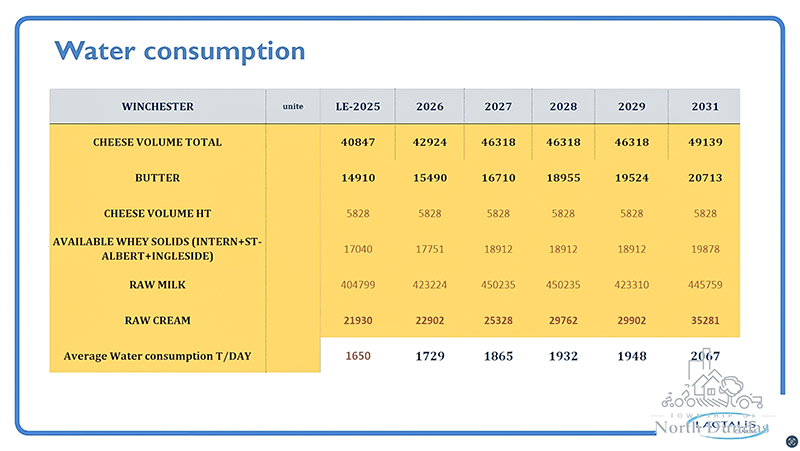
Graphic shows current and projected production of the Lactalis Winchester plan along with its projected water consumption. Courtesy Photo
WINCHESTER – If you were to ask the average person to list the things that they believe are important in creating a community in which people would be happy to live, it would be reasonable to think that somewhere on the list would be the availability of good jobs close to home. They would probably also look for a reasonable tax rate, understanding that everything comes with a cost, but it is a matter of balancing with what you give and what you get for your hard-earned after-tax dollars.
A reliable supply of potable water and a functioning sewage treatment system that can handle the needs of the community not only in the present, but well into the future might not even be mentioned because in the developed world we take this for granted, believing that it is something we are entitled to.
It also though, comes with a cost, and it is a cost the residents of North Dundas may be forced to consider sooner rather than later, as current and future Councils try to solve the puzzle of how to fit together the pieces that are good jobs, manageable tax rates and enough water to serve the needs of the residential, commercial, and industrial population now and well into the future.
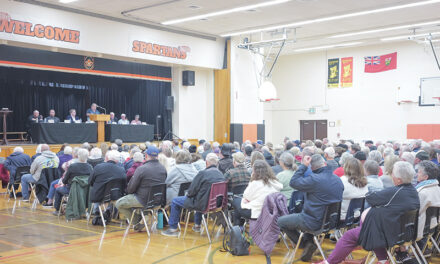
It isn’t a new issue; it has been talked about for years, in North Dundas and other rural communities, but it came to a head at the regularly scheduled meeting of North Dundas Council on Oct. 21, during a presentation by Lactalis Winchester.
The presentation was made by Navid Kobari, Plant Director – Lactalis Winchester and William Bruining, the plant’s Manager-Maintenance & Engineering.
The pair came armed with a short PowerPoint presentation, which identified the Winchester plant as the largest cheese manufacturing facility in Canada. The presentation included a link to a YouTube video produced by SDG Counties (you can view the video at this link: (https://www.youtube.com/watch?v=5OiZhcDgkSE&list=WL&index=27) or by doing a search for SDG Counties home to largest cheese manufacturing facility in Canada.
The presentation outlined the history of the facility, from 1891, when Jack Ault opened it, to the present, including plans for the future.
Numbers played a large part both in the presentation by Lactalis, and later, in comments from Council. For their part, Lactalis reported that:
- They currently employ 263 people from Winchester and the surrounding area
- 70 are salaried while 193 are hourly
- They plan to hire 30 more to fill vacancies
- In 2026 they project they will pay their employees $36.8 million in wages and benefits
The presentation went on to show that they support local businesses, having spent $181,000 to date and expect that to reach $196,000 by the end of the year. On a separate slide they itemized expenditures at local contractors and machine shops with a total of $1,161,464,729.10.
They went on to show other ways in which they support the local economy, from buying 428 million litres of milk from dairy farms in the region, to installing a wastewater treatment facility, to planting 10,000 trees, to supporting local charities and sports groups.
This led to their ask: They need more water.
Lactalis Winchester is in the midst of a three-phase expansion. Phase One, with a value of $14.7 million is the construction of a new milk receiving area with four bays.
Phase Two, worth $41.7 million is the construction of a new cheese belt in a new building.
Phase Three, valued at $35.2 million is planned for 2026-2028 and involves new cheese vats in a new building and additional services such as refrigeration, steam, and compressed air.
The total investment which director Kobari stated has already been slated to come to Winchester is valued at over $91 million. They have already invested $4 million into the butter process.
The expansion would see an increase in the amount of milk processed. Currently, they receive between 2 and 2.5 million kg of milk per day, and that would increase by 25 per cent.
This would allow them to increase their cheese production from 44 million kg to 55 million kg and butter from 15 million kg to 20 million kg in the next five years.
However, to make all this happen, Lactalis Winchester would require an additional 175 units of water in the next three years, this in a community that is still enforcing an outdoor water use ban.
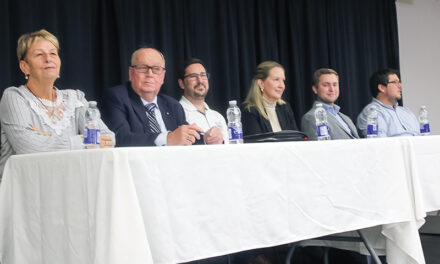
Mayor Tony Fraser thanked them for their presentation and opened it up for comments from the members of Council. The first to speak was Deputy Mayor Theresa Bergeron, who has made no secret of her dislike for the relationship that exists between Lactalis and the community, and she wasted no time in expressing it.
“Well, it’s an interesting presentation on your growth, but it’s come at a cost to the people of the township in lost taxation revenues and in acquired huge debt,” said Deputy Mayor Bergeron. “And it all has to do with the water supply. The fact that you didn’t come to us years ago to discuss your plans, it tells me that you assumed access to unlimited water and the fact we all know, we’re quite aware now that water is very limited.
“In our community for the last four years we’ve had no growth because we’ve had no water. In three years, the municipal portion of our taxes went up 40%. And with this year it’s looked like it’s going to by next year it will be 50 per cent. That’s how much our taxation has gone up locally because we’ve had no water no growth.”
According to the Deputy Mayor, if the water used last year by Lactalis went into new homes, it would have brought in $10,948,560 in property tax revenue. If their overuse from last year had gone into homes, the property tax revenue from new homes would have been $2,313,680, according to the Deputy Mayor. She also stated she was unhappy with their tax levy of $162,000. “Every year like clockwork you pay your lawyers to appeal those taxes to get them even lower,” added Bergeron.
Bergeron went on to list other detrimental effects to the community because of water use by Lactalis, including:
- The cost of accessing a new well ($21million plus interest)
- Household water hookups costing $17,000
- Adverse effects to the township’s reputation due to the water use ban
- Taxes 20 per cent higher than in North Stormont
Bergeron continued, comparing Lactalis to North Stormont based GFL. “GFL next door is the largest employer in North Stormont. Yet they’re an asset to their community and a good corporate citizen. They haven’t prevented growth. They take the garbage for free, saving them millions of dollars. Every year they do a yearly host donation equal to 8% of North Stormont’s total revenues. GFL has donated millions of dollars to fund township projects, recreation, and even a fire truck.”
As for the jobs created, even that was worth of scrutiny. “Yes, you do employ a lot of people,” said Bergeron, “But they’re not all from North Dundas and it shouldn’t be at the expense of the taxpayers.”
Bergeron went on to list other issues but concluded with what she felt was a solution.
“So, this is what I suggest to you,” said Bergeron. “Teach your employees to conserve and not waste water. Bring technology in to recycle at least half of your water. Don’t pay lawyers to appeal our little bit of taxes. Instead, pay lobbyists to get that pipeline to the St. Lawrence River. That’s the only answer. From that, we would both benefit with growth and a reliable source of water.
“Your access to so much water has caused our township undue financial and personal hardships and I won’t agree to any new water allotments while we’re still pumping wells. I don’t want to see another year like this one. Your demand, you know, has dried up our water supply and the citizens of this community, they should be rightly angry for what’s happened. And not just the citizens. I mean the businesses the small businesses have cut back on their water allotments meanwhile you have only cut back to your allotment and so you haven’t really cut back because even with many, many requests from our staff have you cut back to your original allotment so I don’t know how the people here are going to feel once they you know hear all this data on your water consumption.”
Prior to hearing from the other Councillors, director Kobari, asked to be able to respond to some of Deputy Mayor Bergeron’s assertions. Some he would have to speak with his superiors and report back, but there was one thing he did want to make clear.
“There’s a couple of points in here that is important to mention,” said director Kobari. “You said that the water that we’re going to take is for our profitability and not for our people. We know how the market of the cheese works and I’m not here as on behalf of Lactalis. I’m here on behalf of Lactalis Winchester. Part of my job is to advocate for Winchester and the town and people, and the community and I always have in the past 10 years. The issue with the volume is we must stay competitive. So Lactalis, this investment can come to Winchester or to a plant which 40 minutes away from us. They (Lactalis Corporate) would benefit; no issue, they would probably not see any change. Winchester is the one that would.”
The other plant referred to is in Ingleside, Ontario, in South Stormont.
William Bruining added that there are ongoing efforts to try to improve the situation.
“Well, you made some good recommendations there about investing in reclaim, about lobbying. We are pushing for those as well. We have some of our senior leadership. They are they are in partnership with some individuals here pressuring the provincial government and we are also pushing to invest in reclaim technology. The technology is there. It’s very expensive.”
Next to speak was Councillor Lennox, who supported what the Deputy Mayor had said, and seemed to take offense with comments from director Kobari that indicated Lactalis could end up moving to a different community. “We have to expand our population base and our tax base through growth,” said Lennox. “We can expand industry, but that doesn’t help the tax base. Now, when you talk about leaving Winchester or threatening staff over the phone about leaving, you heard it over here. $2 something million increase in our tax base. Yes, long-term it would hurt if you left, but long term the tax base succeeds. Do we want you to leave? No. No, I’m saying that. I know that staff have worked with you and went down several channels. I know there’s been permit issues or hitting water mains or sewer line issues. We’ve worked with you again. We’re scratching your back. We’re not getting a whole hell of a lot back.”
Lennox went on to say he wanted “more than lip service,” and that he expected Lactalis to stand with the Township in pressuring the province for solutions. “We have to champion this and having private sector with public and showing a partnership. The provincial government eats that up. Let’s do it.”
Councillor Matthew Uhrig was the final councillor to speak and was the most conciliatory. “I will say I once sat on the other side of this desk as a local reporter and this is honestly the first time in a decade or more that I can recall you, you know, facing the flame so to speak from the plant level. So, I appreciate that. I do and I can appreciate the passion with which you speak for the Winchester plan and everything like that. And I think you’ve taken enough of a tongue lashing and I’m not here to do that myself, but it’s more of, all of this goes away if there’s no water to give you. I understand what you’re saying in terms of it goes elsewhere, if we can’t come up with what you’re asking for. I understand that, but it all goes away if there’s simply no water, right?
“I think what my focus more than anything is, and it’s very similar to Councillor Lennox, is that I look to the future. What’s the future going to look like?
“You know, we need to work together,” continued Councillor Uhrig. “I think it’s nice to have ideally a positive corporate partner at the table with us when we kind of reach these levels of government and say listen, you know eastern Ontario does exist, there are jobs here, there is good market here, you know remember that the 401 doesn’t stop at Oshawa, we do exist here so you know the next time we have to chat with those Members of Provincial Parliament, maybe they’ll get it, so thank you.”
Mayor Fraser was the final speaker on the matter, and started off ensuring that everyone knew that he, in addition to being Mayor, was an employee at Parmalot/Lactalis Winchester, and had been since the 80’s as a student. He said he agreed about the comments about the Provincial government needing to step forward and admitted that he had expected someone from local MPP Nolan Quinn’s office to be in attendance and was disappointed that they were not. “My goal was to have this presentation readied and have representatives of Minister Quinn’s office here to hear the struggles, the challenges because you know we’ve been working together, trying to advocate for money to come our way to support growth of the business, growth of the village, growth of the villages that consume potable water, both Chesterville and Winchester and the challenges that the two villages face as well as the challenges that our businesses face that have stopped doing business because there’s no water for them to continue doing business.”
Mayor Fraser indicated that through the Township’s CEO, he wanted the Lactalis presentation put in the hands of the Minister of Agriculture, Food and Agra Business, the Ministry of Municipal Affairs and Housing, the Ministry of Rural Affairs, and to the Minister of Colleges and Universities, local MPP, Minister Quinn. “They all need to understand the challenge that is faced in North Dundas for growth. Not just the growth of residential growth, commercial growth, industrial growth, but the growth of our economy, your economy, your viability, our viability. It is a shared partnership. I’m thoroughly disappointed that the province did not see fit to have someone attend this when we’re talking about the largest cheese manufacturer in Canada.
“We need to be supportive of our agriculture, but we also need to be mindful as my fellow councillors have talked about growth and growth of our tax base. a stagnant tax base just goes backwards and becomes more expensive for the ratepayers.”
It’s a difficult situation with puzzle pieces that don’t fit together very well at the moment. One of the communities largest employers needs more water to grow, to be competitive and provide good jobs, but the water they need probably isn’t even a possibility right now. If they do get the water they need, it prevents the tax base from growing and costs for the residents to continue to climb. And with that much demand for water, can the aquifers continue to recharge?
Recycling and conservation could provide some relief in the short term, but a long-term answer involves the province chipping in with a substantial investment, perhaps funding the creation of an intake from the St. Lawrence.
Winchester and North Dundas have been inextricably linked with the dairy industry, seemingly forever. It is a good partnership, but it is careless to think it impossible for that to change. Lactalis needs water to produce cheese, the question is will they get it in Winchester, or somewhere else?
Terry Tinkess is a professional photographer, educator and journalist. He has been making a living with a camera and keyboard since 1999 and has been featured in such publications as The Ottawa Citizen, Cornwall Standard Freeholder, The Globe and Mail, The Miami Herald, Ottawa Construction News, The Ontario Construction Report, Ontario Home Builder Magazine, Reed Construction Data, Canadian Potato Business and most recently, The Record and Eastern Ontario AgriNews. Terry lives in Morrisburg, Ontario with his wife Brenda, Mia the anxious Pittie and cat Chubbers.